From our successful application to the United States Department of the Interior National Park Service to the United States Department of the Interior National Park Service, to add Komensky School to the National Register of Historical Places:
8. Statement of Significance
The Komensky School, constructed in 1912, served a predominately Czech farm community in Hutchinson Township, Minnesota, and is locally significant under National Register Criterion A, for its association with the broad patterns of our history in the areas of ethnic heritage and social history.
The Komensky School stood at the center of community life between 1912 and 1959. Proud of the educational accomplishments of its graduates, the district school board built a substantial two-room brick building. During its years of operation, the school provided space for instruction to children, grades one through eight, teaching the fundamentals that enabled them to take a productive place in the community as they grew into adulthood. Together, with the nearby Bohemian Hall, it formed the nucleus of a close ethnic community. Every summer, the local Bohemian Reading Society conducted a Czech language class in the school.
The strength of that community was tested in the late 1950s when school consolidation forced the closing of Komensky School. In response, a bitter battle erupted as local residents defended not just a school, but also a way of life. It is a testament to the bonds of that community that the local Zåpadnf Ceskå Bratrskå Jednota (ZCBJ) lodge acquired the building in 1959 to serve as a home for its extensive Czech language library. Fifty years later, it is still owned by the Lodge Lumir, now part of the Western Fraternal Life Association, the heir of the ZCBJ.
The school is associated with the historic context entitled “Railroads and Agricultural Development, 18701940,” one of the statewide historic contexts developed by the State Historic Preservation Office. The period of significance begins in 1912, the construction date of the school, and ends in 1959, when the rural district consolidated with Hutchinson and the building was sold to the Lodge Lumir.
A Czech Community
Czechs began arriving in Minnesota in the 1850s. The earliest settlements were formed in Owatonna, New Prague, Chatfield, and Minnetonka Township in Hennepin County. By 1858, a significant community developed in McLeod County, centering around Silver Lake, Hutchinson, and Glencoe. Many of these immigrants came from Caledonia Township near Racine, Wisconsin, and had numerous social connections with the Minnetonka Czech community.
In the land between Hutchinson and Silver Lake, Czechs established a multitude of small diversified farms, typically forty to eighty acres in size, growing grain and hay both for sale and for feeding livestock on the farm. They raised stock for milk and meat, poultry for eggs and meat. Although Silver Lake had a substantial Catholic population, the Czech families that settled northeast of Hutchinson tended to be freethinkers. According to historian Stepanka Korytova-Magstadt, Czechs were the only ethnic group in which freethinkers constituted an absolute majority. She wrote, “In the United States, [freethinking] was a respectable alternative to church-going, one which, among other things, relieved frugal Czech farmers of any obligation to tithe or otherwise financially support the church.”
Like many other ethnic groups, the Czech farmers joined together to organize societies and clubs, with fraternal organizations becoming “the backbone of freethinking in rural America.” In addition, reading and dramatic societies proved popular, providing an outlet for Czech language, culture, and customs.
In 1876, local residents formed the Bohemian Reading and Educational Society, or Ceskj CtenåFskY Vzdélanecké Spolek. Its purpose was to provide societal and educational advantages for themselves and their children and also preserve the culture and folklore of their forebears. Its initial resolutions included a motion to purchase twenty dollars worth of Czech language books each year — a library now housed in the Komensky School. They also organized a Czech choir, a dramatic club, and language classes for young people in the area. Its programs and socials proved so popular that the society bought land and erected a hall in 1883, adding a second story in 1895. A local newspaper declared the Society as “widely known as authorities on old world customs.”
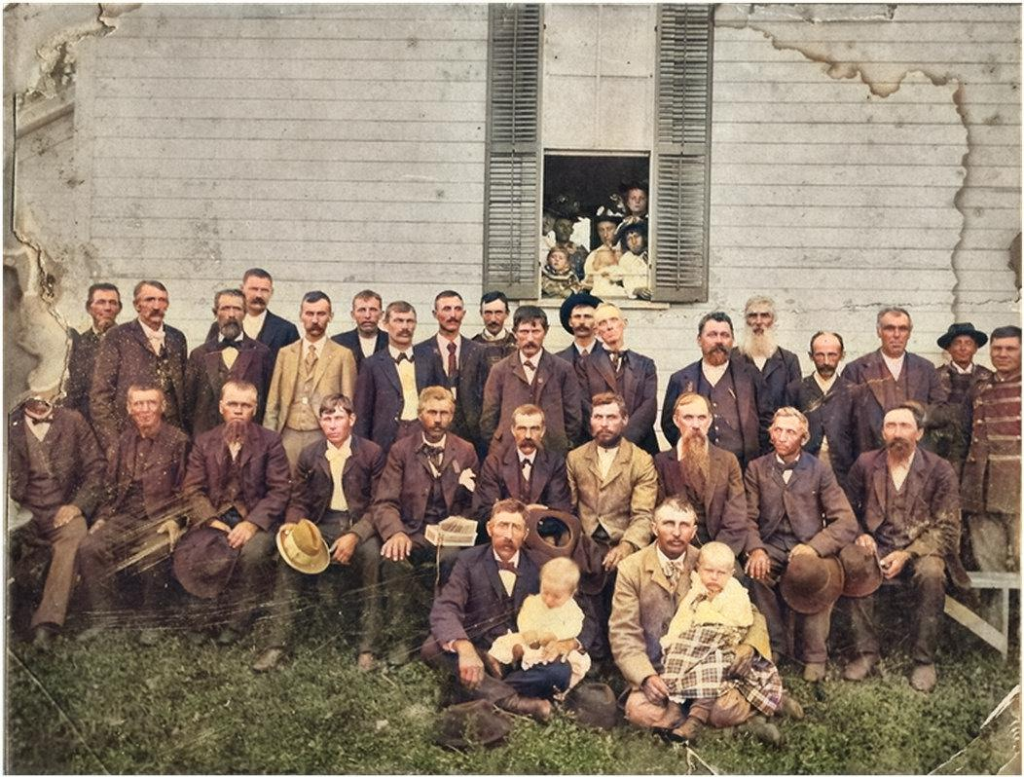
Most importantly to understanding the role of the school, evidence suggests that Czech immigrants had a high rate of literacy — 98.5% could read and write. So it is not surprising that the Czech farmers who settled northeast of Hutchinson paid extraordinary interest in education. This might be reflected in a statistic from 1912, when a Minnesota survey showed that McLeod County was the only one outside of Ramsey and Hennepin to send more than eighteen students to universities and colleges per 10,000 inhabitants.
A New School
Responsibility for education in the township was divided between Hutchinson, home of the high school, and a number of rural school districts. School District Number I I was organized in 1865, with early classes held in a one-room log structure, which burned to the ground. It was followed by another one-room school, built of wood, that served the community until 1912, expanded with one small addition in 1892. By 1910, more than 100 pupils attended the eight-month school — making it the second largest rural district in McLeod County. In response, the local board held a series of meetings to discuss a solution to the serious overcrowding. In March 1910, the special meeting debated whether a new district might be needed, ultimately rejecting that path.
The following year, in June 1911, the local school board called another special district meeting to discuss a new building. The debate centered around three options: an addition to the existing building, a new one classroom wood building, or a more substantial two-room structure. The step to a larger school carried one extra burden: the district would now be expected to support an additional teacher.
The final vote in favor of the larger school was swayed by an appeal from Professor Anthony Zeleny, physics professor at the University of Minnesota. Zeleny made the trek to the meeting from the University of Minnesota in Minneapolis, returning to the school that he attended and where he taught for several years as a young man. A gifted speaker, a University of Minnesota alumni newspaper described him in action, “His sentences abound in concrete images which seem to be built up in the air between you and him by his imaginative speech. His gestures, made with both hands in a shaping, downward-curving motion before him, seem to gather his ideas into a bowl for your inspection.” He said:
To send children to a school where the enrollment is as high as it is in District 11 is worse than useless. Don’t think of keeping this up. We fathers and mothers think it is hard to look after five or six children at home. Think of the teacher having eighty-two enrolled to look after! You are wasting precious time in the early lives of your children. You can’t afford to let this waste go on.
He continued: “I haven’t recovered from the nervous strain of teaching that school to this day. Even now after a hard day’s teaching at the university, I will dream that I have forgotten a class in the old country school in District 11.”
Zeleny’s words carried extra weight because he and his brothers John, Frank, and Charles, represented the highest level of achievement. Dr. John Zeleny was teaching at the University of Minnesota at this time, and then became the chair of the physics department at Yale University in 1915. A 1917 student poll named him “the greatest living alumnus of the University of Minnesota.” Charles was longtime professor of Zoology at the University of Illinois. Frank became a mechanical engineer for the Burlington Railroad.
The reputation of the brothers spread nationwide among Czech immigrants, as one ethnic newspaper claimed, “The achievement of the Zeleny brothers presents a very interesting account, especially at the present time when one hears and reads so much about Anglo-Saxon and Nordic superiority. To Americans of Czech-Slovak descent, it is certainly gratifying to learn that a number of their men occupy positions of importance in leading American institutions of learning.”
Zeleny’s speech swayed the board in the direction of a two-classroom building.
The push for a larger school building was supported by a national emphasis on rural schools, that combined with additional state aid for construction and spurred a wave of school construction in McLeod County. A Hutchinson newspaper story remarked, “An unprecedented amount of school building is going on at present. School houses are being built all over the county. During the past two years the number of State Aid one-room schools has been doubled, resulting in much better country schools at much less expense as the state is liberally granting aid to good schools.”
But the issue was not settled. At a meeting on September 9, 1911, a special district meeting overwhelmingly voted down a bond authorization to build an addition to the existing building — with most of the opposition coming from those who wanted a new structure. Three weeks later, on September 30, a subsequent meeting approved plans for a two-room school by a vote of seventeen to three. The final barrier was breached in February, when the district approved issuance of $5,000 in bonds. “The school will be the finest, the most modern, and most costly building put up in a rural district in this county. Never before has a country district in McLeod County voted so large bonds. Never have the farmers showed such determination to do things right.”
The school board hired local builder Paul Magdanz as the architect for the school, with T. N. Thompson and Frank Bren listed as the contractor. It is likely that Magdanz took standard plans, issued by the state board of education, and modified them. Indeed, Magdanz built two other country schools within a year, with the Algren school constructed “on state plans.” The contract was let in late May, awarded to Frank Bren and T. N. Thompson. Thompson, a bricklayer, had good connections with the Czech community, having recently completed the John Hus Presbyterian Church in Hopkins. The school was completed at a cost of $5,272.50.
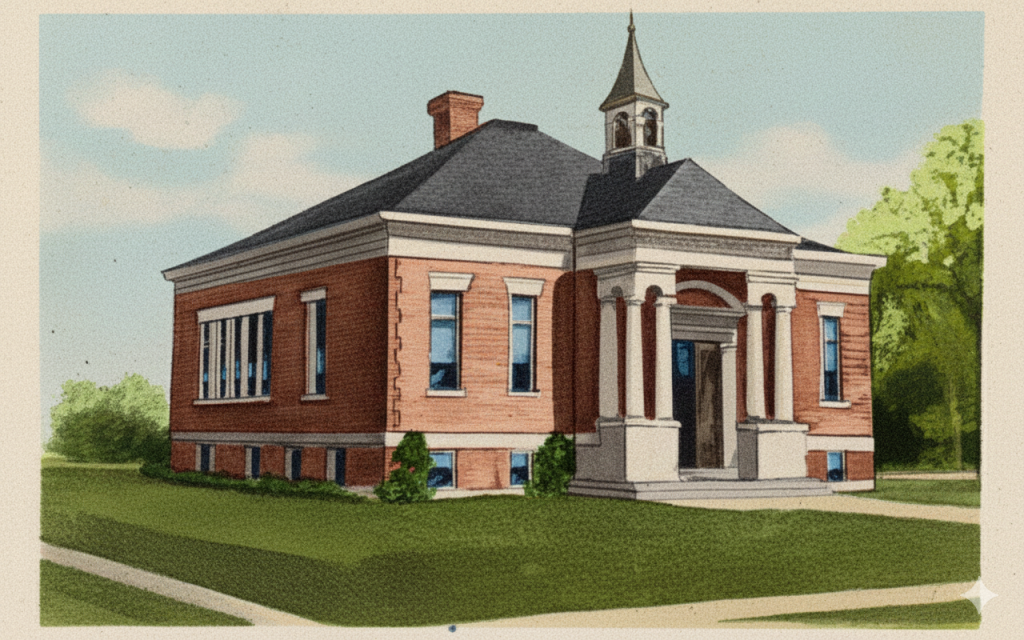
Looking at Magdanz’s plans, one newspaper reported:
The building will be large and artistic, a source of pride to the people of the district and to the whole county. In design it is very pretty, with columns at the entrance and other tasty features. It will have a full-cemented basement with two rooms for future use if so desired. Besides two good large rooms which will be lighted and ventilated according to the latest requirements there are two rooms at the front of the building. One to the south, a little smaller than the other, is the library room and the one to the north will be used as a recitation room or study room if necessary.
One county promotional piece drew attention to the proposed school, stating: “The Komensky school will be the best country school in this section of the state. It represents a new era in rural school education. The school board consulted leading school men in their work, and used good judgment in the smallest detail.”
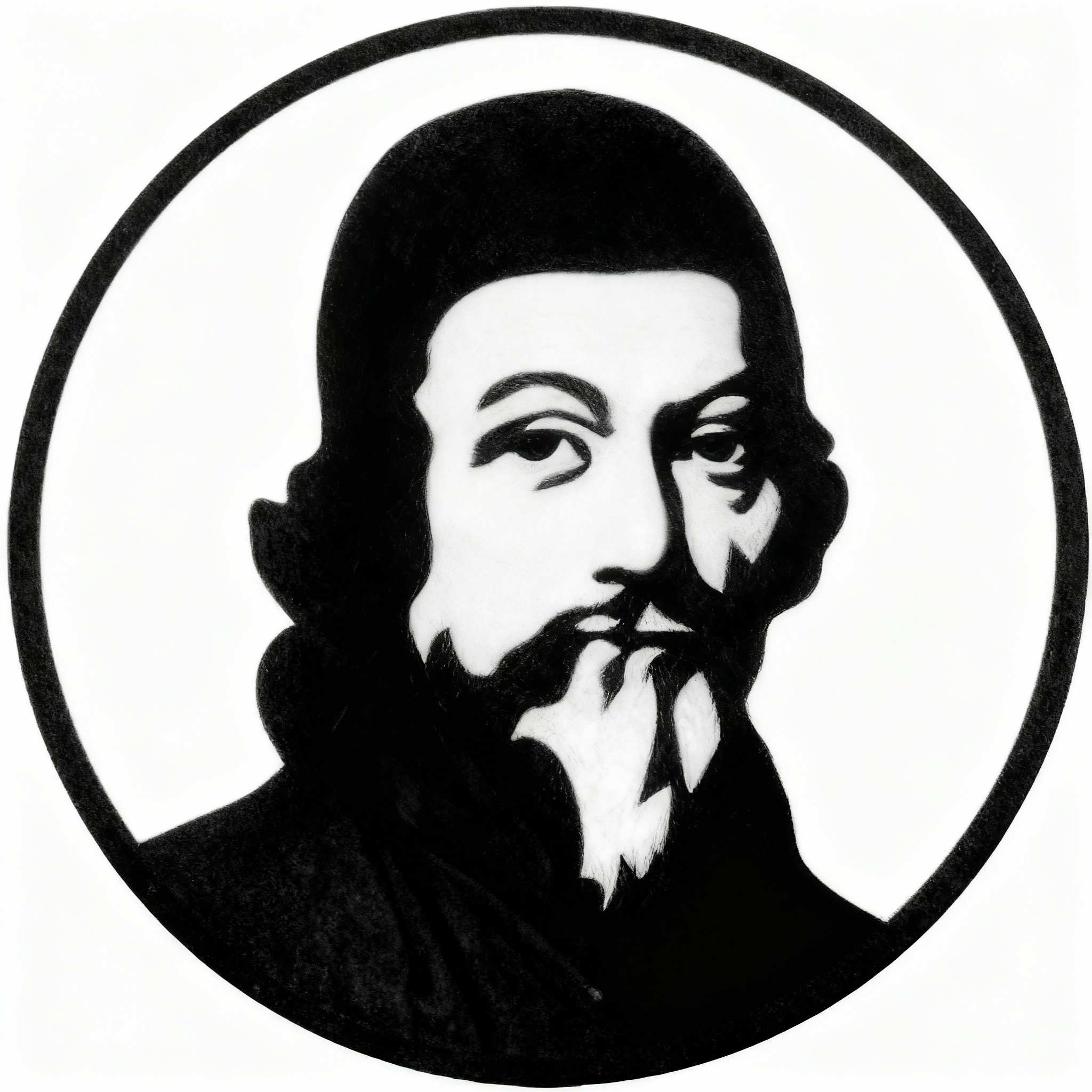
At the annual meeting of the District 11 school board on July 20, 1912, the citizens chose the name “Komensky” for the school, winning over the alternative, Karel Jonas, by a vote of thirteen to seven. Jonas, a Bohemian newspaper editor who became lieutenant governor of Wisconsin, was a particular favorite of local residents, many of whom came through Jonas’s hometown of Racine on their way west. The winning name, Jan Komensky, reflected the educator’s stature in Czech society. Komensky (1592-1670) was a noted Czech teacher, philosopher, and writer, and best known as one of the earliest champions of universal education.
During the nineteenth-century Czech National Revival, Komensky became idealized as a symbol of the Czech nation. His birthday, March 28, is celebrated as Teachers’ Day in Slovakia and the Czech Republic. In Minnesota, the Komensky Society was an active organization promoting education during the period between 1910 and 1930.
When the new school building prepared to open its doors in the fall of 1912, its basic mission, education, was in the midst of a transformative period. Progressive-era reformers placed much of their hopes for social change upon education. Nowhere was that more readily apparent than in rural America.
In 1908, President Theodore Roosevelt appointed the Country Life Commission, headed by reformer Liberty Hyde Bailey as its chair. Bailey described the country life movement as “the working out of the desire to make rural civilization as effective and satisfying as other civilization.” Indeed, the commission’s purpose was “not to help the farmer raise better crops, but to call attention to the opportunities for better business and better living on the farm.” When the commission issued its report, a change in rural education was among the primary goals. The conclusions of the Country Life Commission and other prominent writers transformed popular attitudes toward the role of the public school in a rural community.
These were reflected in the speeches given on Saturday, July 27, 1912, to a large crowd gathered to celebrate the laying of the cornerstone. The Hutchinson Leader trumpeted, “The ceremony of placing the stone was the first ever held at a country school in the state.” A newspaper from nearby Glencoe reported, “Expressions of surprise were heard on every hand from those who never expected to see a school of this size out in the country.
The day was a grand affirmation of the importance of education. The speakers included Professor Asa Weese from the University of New Mexico and Dr. Sam Chernausek. The latter was a school superintendent from Montgomery. He said, “Komensky . . . would tell you that this beautiful building . . . would soon be too small to accommodate the shops, workrooms, and laboratories which will soon be necessary in every country school for the teaching of agriculture, the manual arts, and other things of a practical nature. Education must be made practical and at the same time accessible to the country child.”
Another orator, a District 11-educated University of Minnesota student named William Klima, linked education to the great American dream of equality of opportunity. “The children of this district will have the advantages of one of the best country schools in the state,” Klima said. “That means that they will have a share in a mine that will yield dividends finer than gold. Their parents are building wisely. They will see their children given a chance as Lincoln said a chance to compete with the boys and girls educated in the cities, as well as to get more practical training for life”
The school was dedicated in November 1912. It was described in glowing terms by a local newspaper:
The interior of the school presents a cozy, homelike appearance with its large halls and rooms of various sizes. The dark stained woodwork, pretty windows, and interior stairways from the school room to a basement combine to add to its beauty. The exterior is well-appointed with front columns, a cupola, and large low green-stained roof.
Now that the area had a name, Komensky, it began to transform into a distinct rural hamlet. As early as 1913, newspapers in Hutchinson and Silver Lake began to call the area by the name of its school. Like a farmer’s milking stool, the nascent community had three legs: Bohemian Hall, the Luce Line railroad, and Komensky School.
Bohemian Hall provided a venue for social events, with frequent dances, dinners, and picnics. Its stage saw numerous Czech-language plays, readings, and musical performances. Steadfast to its roots, the Bohemian Reading and Educational Society, which owned the building, conducted its meetings in Czech until 1948.
The railroad was the economic engine. Colonel William Luce built the Electrical Short Line Railway, as the Luce Line was officially known, extending from downtown Minneapolis through the countryside and finally ending in Gluek in Chippewa County in west-central Minnesota. The financial goal of the line was to capture the farm to market traffic originating in central Minnesota and to provide transportation for people to downtown Minneapolis via electrically propelled trains. Luce was granted a right-of-way in 1909, with Hutchinson awarded a full station and Silver Lake a depot. The railroad decided to build a siding in Komensky, opening the door for local passenger and commercial rail access.
In anticipation of the rail service, local residents gathered in the Komensky School in April 1916 and approved construction of a branch of the Silver Lake creamery at the new siding. When it opened its doors two months later, Joe Kosek brought in the first load of milk — and 5,000 pounds total arrived before the end of the day. By 1920, unincorporated Komensky included a creamery, grain elevator, store, stockyard, icehouse, and scale house.
An Educational Institution
As an educational institution, the Komensky School provided instruction and training for several generations of local children. From 1912 to 1959 more than 150 pupils graduated from Komensky.
Attendance was highest in the early years of the school, when it employed two teachers. As a reference point, in 1934, there were twenty-six students. Of those, six were under age ten, fifteen ranged from ten to twelve, and five were aged thirteen to fifteen.
When the school opened in 1912, it had two classrooms. The north room was used for the higher grades and the south for primary grades. By 1932, only one room — the south room — was used for teaching. The north room was used for recess in bad weather and as a lunch room.
Still, the school curriculum reflected the national trends with a manual training room — where boys made birdhouses, milk stools and toys — while girls remained in the classroom to learn domestic science knitting, embroidery, and sewing. There was also a library room with shelves of books and a study area. One former student recalled that it also served as a space for recitations and personal counseling.
Many teachers came through the Normal School associated with the Hutchinson Senior High School, started in 1912. Although Minnesota began a teacher training program in 1894, it remained relatively lowkey until 1909, when, partly in response to the Country Life Commission report, the state superintendent issued guidelines that exempted its graduates from teachers’ examination. Minnesota’s program was “planned to train students directly for the country school experience” and required “training centers located and organized to most effectively serve the state.” At its peak, in 1924, ninety-six departments had been established in sixty-five counties across the state. Komensky benefited from this program, since the Hutchinson graduates often went on to teach in District 11, including Gretchen Magdanz, daughter of the school’s architect. In addition, its students also completed internships and student teaching assignments at Komensky.
The curriculum closely followed state guidelines, and included American history, arithmetic, grammar, geography, reading, and science. Helen Drahos Ondracek, who attended from 1919 to 1927, recalled:
During those eight years I had three teachers. There were thirty to forty students in each room at that time. Before we could graduate from the eighth grade, we had to pass state boards in the basic subject areas. Then we had a county graduation with all the other eighth graders in the county. Academically, I was ready for the ninth grade in Hutchinson, but I wasn’t as mature as the city kids.
Although combining eight grades into one room might seem a recipe for confusion, one area student saw it as an opportunity for learning. He remembered: “I lived next to the school house and went there and thought my education was very, very good there. When you have eight grades in the same room, the first grader will listen to the second grader, the second grader will listen to the third and fourth grader, and by eighth grade, you learned a lot.”
At the close of the school year, a picnic was held, with a potluck dinner, games, and ice cream provided by the school board. The tradition continued after the school closed in 1959.
Komensky School as a Community Center
The Komensky school served as the home of a Bohemian language school during the summers, beginning in 1915 and continuing at this location until 1935. It typically began around June I each summer and lasted for a month. A program and a picnic, followed by a dance in the evening, marked the end of each school year, with money raised to pay the Bohemian school’s teacher.
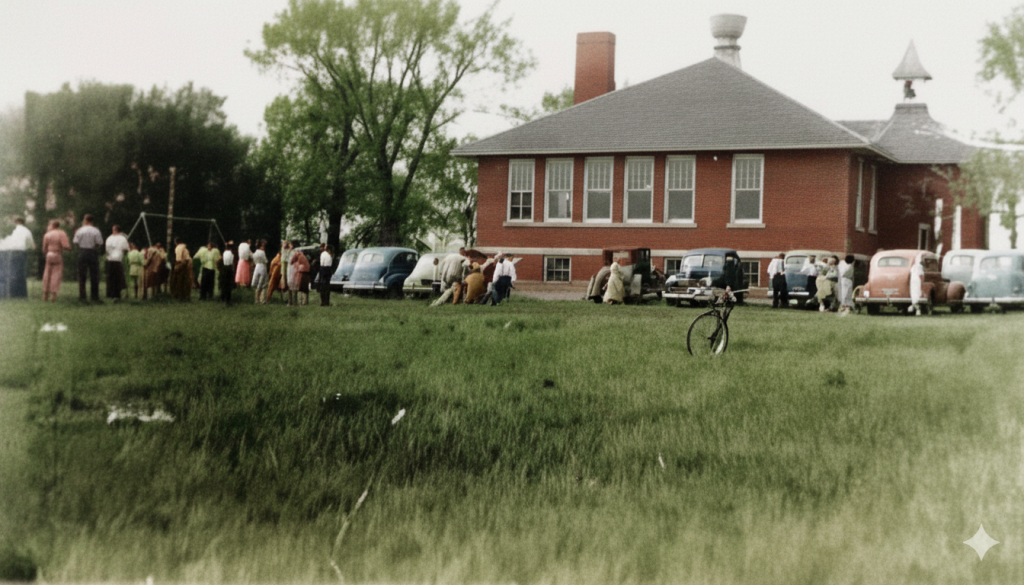
The school provided a meeting place for local farmers, including Farmers’ Institutes where they heard visiting speakers discuss the latest methods. Beginning in 1922, the school board permitted the Farmers’ Union to hold its monthly meetings in the basement. The Farmers’ Union (formally the Farmers’ Educational and Cooperative Union) was organized nationally in 1902, but it was not established in Minnesota until 1918. The organization formed cooperatives, lobbied for farm legislation, sponsored actions such as the withholding of produce from markets to get better prices, and encouraged agricultural education. It tended to be inclusive and family-based with women typically included within the central organization rather than in auxiliaries. By the 1920s the Farmers’ Union was one of the Midwest’s largest farmers’ organizations.
Public social programs grew dramatically during the years and relied on local schools for their execution. In 1904, the first public health services were formed, financed by the Red Cross. The services provided were mainly school nursing, the control of communicable diseases, and infant welfare. Family members usually took care of the sick at home, and were taught how to provide the needed care. World War I brought a dramatic change in the involvement of women in public health. By the end of the war, nearly eight percent of the population had joined a Red Cross Chapter. McLeod County had an active chapter.
On top of the drive to win the war, the influenza epidemic of 1918 and the high rates of maternal and infant death led to major developments in local public health law. By the time the pandemic was finally over in Minnesota at the end of 1920, more than 75,000 people had been stricken, leaving nearly 12,000 dead. Rather than retrench at war’s end, the Red Cross began a new Minnesota program aimed at prevention and education through the employment of nurses. The McLeod County Public Health Nursing Service was established in March 1920 under the auspices of the Red Cross. The county nurse regularly visited the Komensky School, checking for common diseases and administering shots.
During World War Il, Komensky School again served as a rural outpost for the implementation of national policy. Ration cards were distributed at the school. Several former students remembered contests to pick milkweed — found along the highway and railroad tracks — for use in life-preservers for the military. After delivering a bagful, they were awarded a stripe for their efforts.
The Battle over Consolidation
The social and economic bonds of the Komensky community weakened after World War Il. The local economy shifted after World War Il, as highways became the general purpose carrier of people and goods. With the construction of a modern highway system, the Luce Line was bypassed as a carrier of passenger traffic and general goods. Passenger service was the first victim, ending on September 10, 1947. In 1960, the Chicago Northwestern Railroad purchased the Minneapolis and St. Louis, which included the Luce Line. With reduced revenues and maintenance difficulties, the Luce Line was no longer efficient competition against trucks. The railroad company abandoned the line from Hutchinson west to Gluek in 1967. Five years later, the remaining track from Hutchinson east of Highway 494 in Plymouth was removed.
Social connections based on ethnicity also weakened. When only three pupils signed up for Bohemian language classes in 1941, the Reading Society disbanded. Esther Jerabek, writing about the Czech community around Silver Lake in 1934, said:
Men and women who came to the community fifty and sixty years ago have never been obliged to learn English in order to transact business or have social intercourse. . . . With the education of the second generation in the public schools, a bilingual group has developed. Although its members have discarded many of the picturesque customs of their forebears and have adopted those of Americans, they have preserved enough Czech traditions to serve as a link between their parents and the third generation. Until about 1914 the Bohemian language was in general use on the public school playground . . . and a large number of children entered school without knowing English . . . [But] one now (1934) rarely hears Czech spoken by the school children. . . . With the gradual disappearance of the pioneer settlers, little remains to distinguish it from other small villages and farming districts of Minnesota.
The school lost its central role as well. In the last year of full attendance, there were twenty-four pupils. The district voted to send their seventh and eighth graders to Hutchinson in the fall of 1948. A survey, taken two years later, showed the distribution of the district’s fifty students:
20 attend Komensky
7 Hutchinson Junior High 13 Hutchinson Senior High
2 Silver Lake High School
7 parochial school in Silver Lake
Attendance continued to dwindle and by 1958, only thirteen students enrolled in the school.
Beginning in 1947, the state department of education pressed for consolidation of rural school districts. Twenty percent of the state’s districts had an enrollment of fewer than ten pupils — seventy percent fewer than nineteen students. Legislation authorized the formation of county-level committees to hold public hearings, survey current schools, and make recommendations about reorganization. These groups were supported by a state advisory commission. As one state bulletin stated, “As a result of these local studies the people discovered many shortcomings in the district organization. . . . They are proceeding through reorganization to set up new local districts which are large enough to do efficiently and economically the job of providing such education.” According to the state commissioner of education, benefits included more efficient administration, better trained teachers, improved classrooms and libraries, and greater opportunities for vocational education.
Over the next decade in Minnesota, the structure of education was radically transformed as more than 4,100 small districts were merged into larger ones. This equaled nearly 14% of the nation’s closed school districts. A government study said that in most states (including Minnesota) “the reduction in the number of school districts was almost wholly the result of leadership from the state.
It was met with community resistance. As one area resident wrote, “The closing of the Komensky School was stormy. There were many sessions with the county superintendent of schools and principals in Hutchinson and Silver Lake.” JoLen Bentz remembered the turmoil of those years: “It was family against family. Neighbor against neighbor. Friend against friend. At a June 1957 school board meeting, Clyde Drahos made a motion that “the district should not be divided and the school board should do all in their power to keep it in one unit.” It was overwhelmingly approved. Another attempt to dissolve the district came in July 1958, with 64 voting to keep the school open and 27 in favor of closing it.
Then, in September 1959, the Hutchinson Board of Education dropped a bombshell. It sent letters to all rural districts stating that the senior and junior high schools would not accept students from other independent district after the current school year, setting April I as a deadline for a decision.
After years of resistance, opposition crumbled. On November 17, the Komensky District voted to dissolve and join the Hutchinson system by a vote of 42 to 28.
The battle did not end there. Several families petitioned to transfer their children to the Silver Lake School District, hiring a lawyer to represent their interests. At a January 1959 meeting with the county commissioners, the county attorney, and the Superintendent of Schools, these residents engaged in a confrontation with the Hutchinson representatives.
Rather than face a protracted lawsuit, the old Komensky district was split between the two nearby towns. The decision was sealed on February 9 and 10, 1959, when the district voted to assume a proportional part of the debts of the Hutchinson and Silver Lake School Districts.
An editorial in the Silver Lake Leader summed up the heart of the conflict.
“It might be well to consider the following, when a farmer annexes his land to an urban Independent District:
What is the ratio between city and farm voters? Can the rural vote actually carry any election?
How do[es] the Board of Education stand in past years? Do they represent both the town and rural areas or have them become conscious of rural areas only when they are a necessity because of the big tax base they provide?
Where is the farmer’s church affiliations, his community groups, his 4-H clubs, his friends, which community do they spring from? Spiritual and cultural ties are strong and must be judged at a time such as this.
As the last question suggests, the battle was fought on bigger issues than the simple question of school consolidation. Local resident Jerome Kadlec remembered, “The local community was dissolving. John Hus Church was gone. Bohemian Hall was closing. Then the school goes. Pretty much everything in that area was coming to an end.”
Fittingly, given the strong ethnic associations behind the school, when the school closed in June 1959, it was sold to the Lodge Lumir 34, of the Western Bohemian Fraternal Association — better known as the ZCBJ. The following year, Bohemian Hall was demolished. Its substantial library of Czech language books was moved into the new quarters. The building has remained in the hands of this organization — renamed the Western Fraternal Life Association — for fifty years.
Conclusion
Wayne Micka, who attended the school in the 1940s, said, “I’m Czech and I really felt strongly about family — and family was right here in your own district.” That close association of a rural school with family and ethnic traditions encouraged the local farmers to build a substantial two-room brick building in 1912, one that they heralded as “the finest in the state.” Under intense pressure to close in the 1950s, as state policy forced consolidation of rural districts, local residents fought back and eventually acquired the school building to use as an ethnic-oriented community center — a purpose it serves today.
The building represents a period in Minnesota history when an important ethnic group — the Czechs — made the three-generation transition from immigrant to full American citizenship — without losing its identity in the melting pot. It is therefore eligible for the National Register of Historic Places under Criteria A, representing ethnic and social history.
